
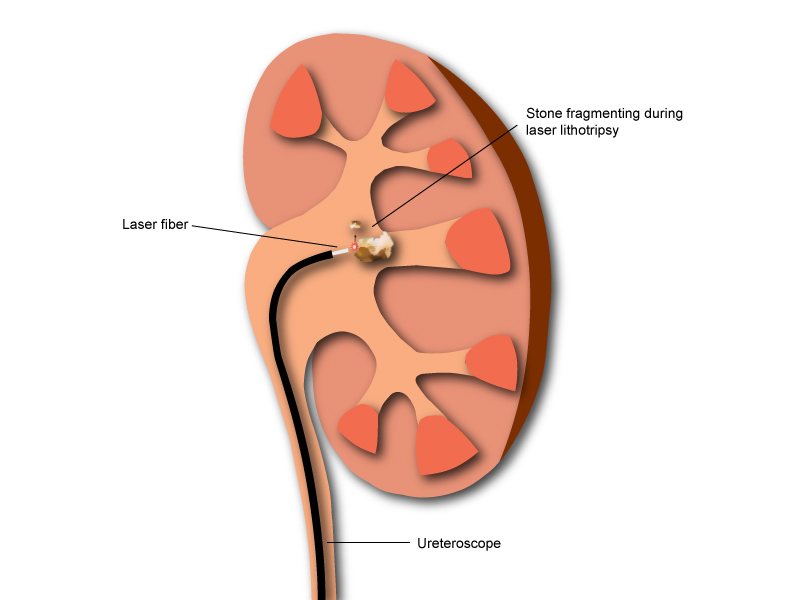
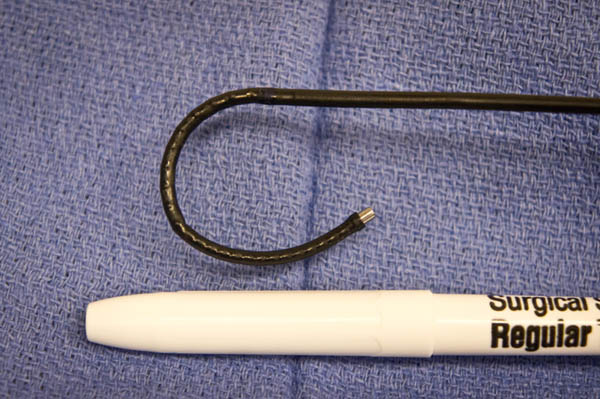
Ureteroscopy involves the use of a small flexible or rigid device called a ureteroscope to directly see and treat stones. The ureteroscope device, which provides a video image and has small “working” channels, is inserted into the bladder and up the ureter until the stone is encountered. The stone can then either be broken up with a laser fiber or pulled out using small baskets that are inserted into the working channels. The advantage of this type of surgery is that the body’s normal openings are used and no incisions are necessary. A photo of a flexible ureteroscope and a video of ureteroscopy with laser lithotripsy is shown below.
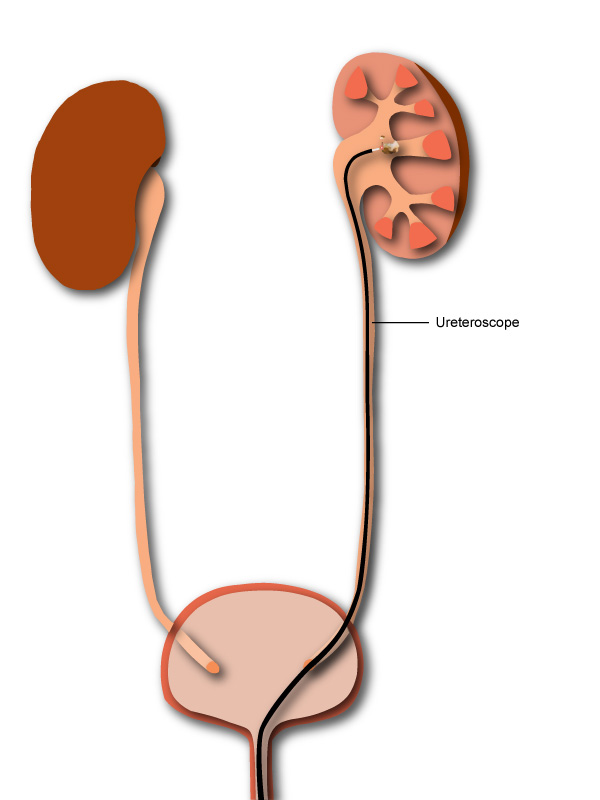
Ureteroscopy often a good option for small stones in the ureter or kidney. Its success rate at clearing these types of stones is generally higher than that for shockwave lithotripsy. Compared with shockwave lithotripsy however, it may associated with increased discomfort after surgery, especially when a stent is required. Ureteroscopy also does not always work as well with very large stones, as the small size of the instrument makes it difficult to completely treat and remove such stones. In these cases a percutaneous approach may be preferable. For more information on comparing the surgical options for kidney stones, see our comparison chart.
Fast facts about ureteroscopy:
- Typical operative time: 1 hour
- Usual hospital stay: Usually none, ureteroscopy is outpatient surgery
- Average number of days before going back to work: 8.5 days
- Average number of days before feeling back to normal: 15.6 days
Data regarding return to work and recovery from a study by Pearle and colleagues, Journal of Urology, 2005.
Video of flexible ureteroscopy and holmium laser lithotripsy in a patient with multiple large uric acid stones.
[…] lebih dari seminggu sebelum seseorang merasa dapat kembali bekerja setelah prosedur […]
I am 57 years old and I have a 15mm stone lodged in urethra on my left side. Surprisingly I have had no pain or discomfort, which, according to the Dr, is why it has gotten so large. I consider myself a tougher than normal guy; however, I am scared to death. I normally deal with pain pretty well, but this type of pain is questionable. I appreciate everyone’s story in here and have heard some good advice. Hopefully things will things will go well.
Had my laser ureteroscopy done today for 2 kidney stones, a 6mm one and a 4 mm. The intervention itself was straight forward, no sickness and I am now stone free. The real pain is caused by the stent which can be quite severe for the first few hours. Peeing was a struggle for me the first 3-4 times. But yes, definitely hydrate and don’t be afraid of the pain as it will improve once you start peeing regularly. I will write an update if things get worse considerably over the next few days. Good luck to anyone having this done.
Hello,
I am a 60 year old woman who underwent ureteroscopy with lithotripsy for a 1.5 cm stone in the lower posterior pole of my left kidney on April 13th, 2022. The absolutely best advice I received from my doctor (which I credit for minimizing my post-op pain) was to hydrate! When I got home from the procedure, I couldn’t get comfortable due to the pain and urinary spasms no matter whether I stood or sat or walked around. However, I was advised to drink 16 ounces of liquid every hour for the first 2 hours post-op. I discovered to my immense amazement that as soon as I started doing so, my pain started to decrease! I have since found out that it is good to drink 96 ounces of liquid a day so I have kept doing so ever since my surgery. In order to be able to drink that much liquid, I have been drinking herbal teas. I am told hydrating will help prevent new stones in the future.
I hope this helps,
Jeanette
I had a ureteroscopy done on a stone in right kidney. Somehow, a piece of the “basket” that they gather the stones with broke off in my kidney. Now, I have to have another procedure to make sure they get the piece out.
Oh, also, there was much more pain after the procedure than I was prepared for. Very disheartening.
After having my stone removed and having a Stent placed I’m not able to urinate normal. Only drops come out. Is this normal? And if it is, how long does it last?
Has any one here experienced URS lithotripsy using only regional anesthesia, no sedation?
I have very large stones in both kidneys thought to be at least partly Stuvite type. I intend tto avoid GA & sedation at all costs. Just want to know others experience using this option.
Anyone has any plans experience of removing 12mm stone in lower pole of kidney ? Is it possible with ureteroscopy ?
[…] may be over a week before a person feels able to return to work following a ureteroscopic procedure, however, and full […]
I started my period and have a ureteroscopy scheduled for Thursday. Can I still have the surgery
I had a kidney stone removed by laser and now my feel are swollen. Should I be concerned and what should I do?
I had a ureteroscopy done in early 2017 (age 46 at the time) to get rid of a 6mm obstructing and two 4mm non-obstructing stones on my right side. The 6mm stone was periodically blocking my ureter and causing extreme pain when it happened.
The first ureteroscopy attempt discovered that my ureter was too narrow for the scope. A stent was put in place while I was under to keep the path clear and to widen my ureter over a few weeks. After the procedure, urination was EXTREMELY painful for 2-3 days (had to bite a towel to avoid screaming), with that pain tapering off over the next 4-5 days. I found the stent uncomfortable, but not painful. In addition to the antibiotic and pain meds, I was told to take Colace (stool softener), Flowmax (improved emptying of bladder), Myrbetriq (reduces bladder spasms), and Pyridium (relieves urgency / pain of urination) in addition to the pain drugs & antibiotics.
A couple weeks later I had another ureteroscopy attempt (and stent replacement). This one was successful. Far less blood in the urine post-op this time, and far less pain while urinating. The new stent was just as uncomfortable as the previous one.
Two weeks after the second ureteroscopy it was time for the stent removal. According to my urologist, to a man in his 60s the stent removal with no anesthetic is normally no big deal. To a man in his 20s it typically requires general anesthesia to endure it. I was apparently young at heart. If I ever have to do that again I will be under.
I’m in almost the exact same spot you were after my first attempt to retrieve the 6mm stone… Thanks for the tip on the stent removal… Will definitely request to be out…
[…] may be over a week before a person feels able to return to work following a ureteroscopic procedure, however, and full […]
I had a ureteroscopy yesterday August 1. I am a 54 yo woman who has had and passed stones before so this is my first procedure like this. Even though I am just under 24 hours out, I thought I would share my experience as I found this forum helpful. Everyone experiences and manages pain differently but hopefully this will help to shed light on how I am processing this. Note, I also got a second opinion and ended up aligning with the second opinion doc to do the procedure. And so if you have any doubts about a urologist or what they tell you, trust your intuition to inquire with someone else. Best decision I made to go with second doc, he is fabulous!
I had three stones on my left side, one at base of kidney at the ureter, and then two in the ureter all causing minor blockage. Urine getting through but not a lot. I also have a stone on my right side but more a cluster of small ones. They are watching that.
So yesterday was the left side and he got them all, and I am very grateful. I hadn’t had much pain surprisingly as these were around 9mm stones. It was an outpatient procedure that took about two hours and under general anesthesia. Recovery uneventful thank goodness. They do not let you leave without urinating. I experienced very little blood in hospital, some burning but that is to be expected. They gave me pyridium and something else for bladder spasms which both turn your urine orange and for a while, so do not be surprised at that.
Today and less than 24 hours past the procedure, I am recovering quite well. The stent causes me minimal pain, more twinges than anything but they are all localized to the area that it sits and occasionally a low back twinge as well. The urine burning is worst at onset but if you take deep breaths it helps and once the stream starts the burning subsides a bit, at least for me it does. No blood in urine.
I have been able to avoid narcotic pain killers and intend to keep it that way. For now Advil low dose seems to really help. Also chamomile tea acts as a natural anti spasmodic and so I use that to help as well. Overall I feel pretty good under the circumstances. I could not have passed those three stones on my own as they were too large. I did try Stonebreaker which has been mentioned many times. I used it regularly up until about a week pre-procedure. It didn’t break them up but what I feel it did which is one of its uses, is help to open the ureter, increase flexibility to help with either passing naturally or for the doc to easily insert the tools necessary for blasting or dusting.
I do have to keep the stent in for another 12 days to help my kidney to drain and any leftover stuff to pass. As I feel right now I do not think this will be an issue. I will update my experience in another few days once I am really past the procedure.
Happy to answer questions if anyone has them! Be well.
Would love an update on your recovery. I am debating whether to have an Uereteroscopy for a 5mm stone in the upper pole of my left kidney. Since discovering the stone I have had severe anxiety about leaving the house and the impending pain from having to pass the stone. But am also terrified about the option of a uereteroscopoy.
Just had a utereroscopy last Friday and thought I would share as this site both freaked me out but also let me know it might not be that bad. Had a 7mm stone at the junction of my ureter and bladder so the journey was almost over. Don’t remember anything about procedure as I was under general but woke up with a stent and not a ton of pain, more discomfort than anything(I have a high pain tolerance). First urination in the hospital wasn’t terrible as I am sure some of the anesthesia was still numbing the pain. First urination at home before the Prydium and hyrdocodone kicked in was a little rough(pain on 8 for a couple seconds). Only used Prydium the first day as it made me nauseous. Pain for subsequent urinations was reasonably painful for the first couple days(6-7). The pain would radiate from my penis all the way up through my flank and into my kidney. However, this pain only lasted for a few seconds and I learned very quickly to take deep breaths when urinating. Holding your breath made it much worse. Another way to lessen the pain for me was by pushing into my kidney and side with my hand while urinating, just like you would a sore muscle. My urinations in the AM had blood but it would diminish to disappear as the day went on. The stent was almost do discomfort at all most times when sitting or walking. Had my stent out this AM and seem to be good at this point. Overall, there were moments of pain as to be expected but much less than I was prepared for.
Hi Corey
Did you experience much pain after your stent removal? I am reading about that and it seems a good amount of people experienced kidney stone like pain after it was removed. I too have a high pain tolerance and so wondered what your experience was like. I am scheduled to have my stent removed 8/14.
Thank you!
What do you think of Nephrolithotomy?
[…] may be over a week before a person feels able to return to work following a ureteroscopic procedure, however, and full […]
[…] may be over a week before a person feels able to return to work following a ureteroscopic procedure, however, and full […]
[…] may be over a week before a person feels able to return to work following a ureteroscopic procedure, however, and full […]
44 year old women, had ureteroscopy with stint, removed obstructing stone however was told that my kidney was mass producing stones. This done in the beginning of May after waiting 1 month. After procedure had so much pain that I was admitted to the hospital for 2 nights. Had so much pain the doctor promised to take the stint out after 4 days. Stint was removed and I thought I wanted to die! Days later major bladder and kidney spazams. 14 days later, all of which spent in bed still have pain while urinating. NO infection, what is causing all this pain? Dr. just completed a few tests: Ultrasound, 24 hour urine test, and urine test. No infection, waiting to hear about the results. I am going to try to return back to work but I am afraid to go since once I move about I get into allot of pain. Any advice?
You can also try Chanca Piedra tea, I have purchased this as well, but have not used as the pill form worked well for me. Probably many different manufactures so I can only testify to the one that worked for me. See the company in previous comments, best of luck!
For anyone suffering from Kidney Stones try Chanca Piedra. ( Stone Breaker) I’ve had well over 30 stones in my lifetime and found this after my last lazer lithotripsy had limited success with a painful stent.. I was told at my follow up appointment that I had 4 stones remains from .55 to .76 in size and would likely need follow up surgery I ordered two types of Chanca Piedra ( pill form) on Amazon from EU natural out of San Jose California. I was very skeptical but have tried ever other natural remedy with no success. You can do some research on youtube but this stuff has been amazing, drink plenty of water and follow directions. From what I can tell this seems to expand your ureter and make the stone much much easier to pass. I had no pain whatsoever when I passed the stones ( which is crazy) it doesn’t dissolve the stone as some people claim. I’m still in disbelief that it worked as well as the claims, but this is the cure your looking for.
I am awaiting a phone call to schedule A Ureterscopy, and I have to tell you after reading all of these comments I am terrified of the pain that comes after words with the stent, is it like this for everybody or is there somebody out there with good news? Such as it wasn’t that bad, and it hurt just the first day, anything positive at all? Is the pain worse than pain associated with the stones?
I had Ureteroscopy and Laser Lithotripsy on Aug 1. The first day after wasn’t too bad – all the usual burning, stent discomfort, etc. It was the second day out that was awful. Pain, discomfort, nausea, vomiting. Fortunately, that didn’t last long. I go on Tues for stent removal. I am ready to get it out because it is pretty uncomfortable and makes it tough to get things done.
I know you’ve experienced it by now, but for me, it goes from intermittant waves between 6-10. Medication takes it to 5-8. The stint is really uncomfortable but not sharply painful, per se. I had a rough stint extraction and had some sharp pangs (8-9) for a couple hours, then they disappeared. I have read taking 3 Aleve before (and maybe a valium) would’ve helped with those spasms.
I’ll say this, I been through 2 ESWLs and 2 ‘scopes. I am having one Friday, and am looking forward to it. It’s less overall painful, but it’s more consistant and achy pain afterward. I have been trying to pass a 5-6mm for 4 weeks, already passed 2x 4mm and 1x 3mm.
I hope anyone reading this is at least comfortable. I have compassionate doctors so I am ok. Best.
My laser lithotripsy was a breeze. Great surgeon(s), anesthesiologist and surgical staff. Had a stent for a week. The stent was uncomfortable because I sit at a computer for my work but not really painful. The meds for burning while urinating and bladder spasms did their job but I did feel a little “blah” with them in my system. Advil gel caps were enough to deal with the stent discomfort. I pulled the stent out and was actually feeling better than before because I was staying hydrated. The fact that everyone in preop and the OR knew what they were doing and were excellent, lessened my anxiety considerably. Take a deep breath and trust them.
I did not have a stent and still had very significant pain for an obstructing 11mm stone which I underwent laser lithotripsy on a general anesthetic. The pain presented 24 hours prior to surgery – no idea I had a kidney stone prior to that and this was my second in 20 years (first passed on its own in a day). Admitted to hospital, sonogram and 4D MRI scans, then surgery in the same day. Initial pain was quite intense afterwards. Urination was something you now prayed you never had to do again. That pain level was gone in 2-3 days. Significant blood in urine during this phase as well. That said, if I drink anything less than a gallon of water a day even now, I feel significant pain when I feel an urge to, or am actually urinating. There is still blood in my urine every 3-4 days or so. This was Dec 5th. It is now Mar 22. I was originally told that full recovery could take 3-4 months, but as time goes on and the pain remains I am getting skeptical of the initial success the doctor claimed.
I had laser lithotripsy to remove a 13 mm stone that was identified using a ct scan on my abdomen. I thought I was dying. I felt sick, weak, nauseous, and like my waist was in a vice. For almost 2 years before the stone was finally identified they would give me antibiotics after x rays revealed nothing and send me home to be in agony again. After the ct scan, they realized they had misdiagnosed me 5 or 6 times, and they scheduled me for the lithotripsy procedure. I was put under general anesthesia (which paralyzes your organs for a few days) and I woke up groggy, with a nurse leading me to the bathroom. I was weak, so I sat down to pee and saw a piece of string wrapped around my penis and held with tape – this was attached to the stent that was placed in my ureter. I urinated blood and was told the procedure was a success, that they blasted the stone into dust, and that I would recover within two weeks after stent removal which was a week. After the hell week of trying to live with the stent, it was removed at the urologist, and I started healing up . . . I thought. I felt totally fine and back to normal for almost a month, and then it all came back to a level of 4 or 5 in relation to the 10/10 I felt before the procedure. I went to the urologist for a follow up, and they did a renal ultrasound, which showed a white spot on my kidney. The urologist started by saying his job on that day was reassuring me that the spot could be water, and he wanted another renal ultrasound in six months. I told him I was feeling pain and discomfort all over again, and he stopped trying to explain anything and took me to schedule another another ultrasound. I’m constantly tired, food won’t digest properly, and I have weird pains in various parts of my abdomen that started with the kidney in question. I’m aware that kidneys are supposed to filter toxins from the body, so if my kidney is not functioning properly, it could be poisoning me. I’m thinking that spot on the ultrasound might have been a burn from the laser, and this might explain why the doctor abruptly changed his tune when I told him the symptoms were back. My chest feels tight and uncomfortable sometimes, and when I was fixing a sandwich last night, I reached for a kitchen knife and felt a brief, searing pain in my chest like a white-hot claw ripped over the center of my chest. All of this has given me severe anxiety, and I’m terrified of eating or drinking anything that might make it worse. My ultrasound is scheduled for next month, but I don’t know how long I can take this. I’m taking care of my mother who was diagnosed with multiple myeloma last year, and my ability to fulfill my responsibilities is becoming increasingly difficult.
If the next visit to the urologist yields no results, I am just screwed. It’s clear that they are playing it by ear, which only exacerbates my anxiety. My faith in the medical system is at an all time low. I haven’t felt normal or calm in months, and it’s taking its toll on my mental faculties, not to mention whatever it’s doing to my body. I’m out of carrots and sticks. They really don’t care whether I live or die, and I would have no problem with either (I’m 48, male), but there is no one else to take care of my mother. I’m constantly confused, angry, in physical pain, or all of the above. This was supposed to be a routine procedure with quick recovery since all my labs, bloodwork, blood pressure, urine samples, etc came back perfect. I feel helpless and betrayed.