
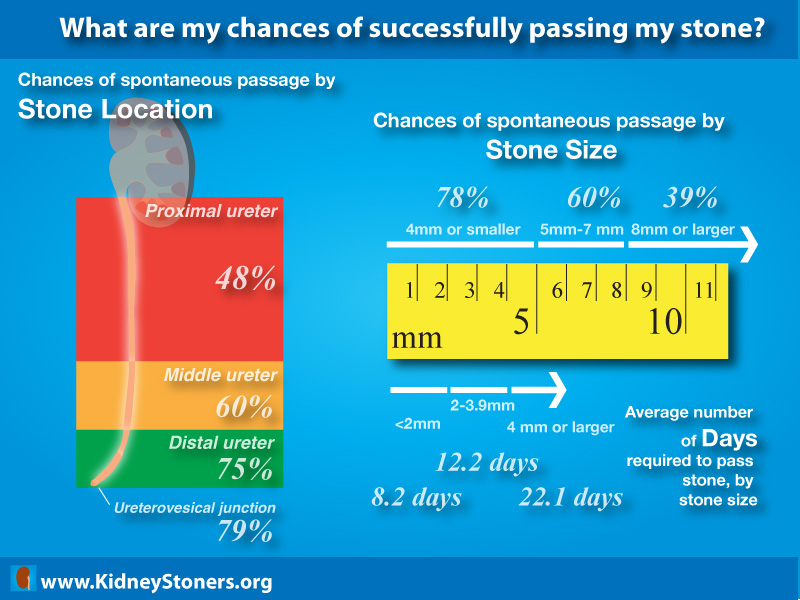
We frequently receive questions from patients trying to pass a stone who want to know whether they will be able to pass it successfully. There are three main factors that your doctor uses to predict your chances of successful stone passage. These include stone size, stone location, and what length of time you have been trying to pass the stone. We go over each factor in the infographic below.
References
Coll, Varanelli and Smith, “Relationship of Spontaneous Passage of Ureteral Calculi to Stone Size and Location as Revealed by Unenhanced Helical CT”. American Journal of Roentgenology, 2002.
Miller and Kane, “Time to Stone Passage for Observed Ureteral Calculi: A Guide for Patient Education”. Journal of Urology, 1999.
I was told I have an 8mm kidney stone, is there anything I can do to increase the chances of passing this stone safely or am I asking for trouble by taking this chance? Also, with lithotripsy, why is it that below, this is the only website I could find online that tells you all about the risks in details? It is making me want to step back and think again but maybe that’s the reason all the risks aren’t posted everywhere because too many in the medical industry are more concerned about their profits than they are about the well being of the people and that’s very sad.
https://www.ncbi.nlm.nih.gov/pmc/articles/PMC2900184
I had pain 3 times for 3 to 4hours continuously, at the 3rd time i visited doctor, so when i check at ultrasound, they found that i am having 8.9mm stone but moved to bladder now. So waiting and taking medicines and water.. not feeling pain now but very worried that how will it pass
I was just released from the hospital with a 10mm stone in my left kidney that had been reduced by lithotripsy the day before from 14mm. Immediately after the lithotripsy I initially felt fine, but by the time I got home I was in absolute agony and started getting nauseated and throwing up, so ended up in the emergency room. Was admitted to the hospital where they inserted a stent and experimented with different combinations of drugs to get the pain and nausea under control (dilauded (sp?) and Atavan seemed to be the magic combination for me). Was also prescribed Flowmax but haven’t taken it yet. Am wondering if it’s even possible to pass a 10mm stone through a 2-3mm opening? It sounds impossible to me. I NEVER want to go through that much pain ever again, and I’ve been through some very excruciating types of pain in my life. ( I also have systemic lupus, RA, osteonecrosis, collapsed lungs and several lung surgeries, a liver abscess that was drained while I was awake with only numbing medication and demerol for the pain, etc., so I know just a little about pain, not to mention I’ve had two full term pregnancies and births.) What I want to know is if there is a less painful way of getting rid of this huge stone other than passing it? (i.e. surgery?) And on top of it all I have another stone in my right kidney that is also bothering me. I have hyperparathyroidism, which is the cause of all my kidney stone problems. When the parathyroid glands are overactive, usually because of a benign tumor on one of the four tiny glands, it causes calcium to be withdrawn from the bones and teeth and deposited in the bloodstream where it ends up being filtered out through the kidneys, and voila, kidney stones! Unfortunately I have had too many other health problems going on at the same time so I haven’t had a chance yet to see an endocrinologist for the hyperparathyroidism. Dealing with my lupus seems to be a full time job because it’s in the severe category. Sometimes it’s hard to know what disease takes precedence from day to day. I’m also losing weight for no reason, down to 109 lbs from 140 lbs and I’m 5′ 7″ tall, so am way too thin. Am also dealing with osteoporosis and fibromyalgia and Sjogrens syndrome and hemochromatosis. It never rains but it pours.
Any insight?! I have a 2mm stone in my left kidney. I’ve had twonprocedure to have the stone removed (it was 6mm) and now this small stone remains. It has been since July, a little over 2 months, the stone has not moved. I have been drinking water, wiggling around, rest on the right side and anything else to help move it! I started to feel depressed about it and gave up on excessive amounts of water daily. I’m back at drinking 1 gallon of water. I have been feelings some pressure in my left side. I see the urologist in December, but the physicians assistant at urologist office next week. Just wondering if this is unusual to be waiting SO long for the stone to get going? I had the original stone lasered, didn’t work it moved into the kidney, followed by shockwave, made it smaller but still in kidney. Feeling really frustrated. Any insight into this??
Pray for God’s wisdom and direction on what to do as this is a tough one. Lean not on to your own understanding and trust in the Lord and He will guide you and put you on the path in the right direction.
http://www.PatFrancis.org
I would love to hear the ending to this story. It is exactly my experience, first stone removed for me extremely painful! Second stone a year later was found in June. Family is getting tired of my frustration. Nice to hear the frustration is normal! Making every effort including the little exercise you mentioned..wiggling, yoga etc. Work, no work..off on so annoying.
When blood was found in my urine in Feb, I had a catscan done which showed a 9mm kidney stone in my right kidney. I had a large stone about 15 years ago, and my mother also had kidney stones, so I was told that I was very susceptible to getting more.
The urologist recommended the “usual”…ESWL or ureteroscopy. I was hoping to avoid both.
I had heard of, and read other reviews on the herb, Chanca Piedra, so I decided to give it a try. I took the capsule version (at about a triple dose of what the daily recommended amount is), and within about 8 weeks, I started to see the grain like shreds of the stone coming out in my urine.
Now, I still take about 2000 to 2500 mg per day, just a maintenance, and from time to time, I still see shreds passing.
I am so glad I started this, as I haven’t had to go back to the hospital since…
I have pen head size stone in both kidney .And how to remove this . I have suffering last 6 moths.
Please guide me what medicine I take .
I have been dealing with a 3 cm Kidney Stone for 3 years. Doctors tell me it’s too high in the kidney for surgery but i still get to have all the pain, frequent UTI, frequent urination and blood in my urine. Anyone else have a kidney stone this long? I am going to a new Urologist in June to see if there is anything he can do for this. I’m so tired of the pain coming and going for the last three years. My original Urologist told me he thought I was at the beginning stages of Kidney Cancer, but was not running any test or anything. I just really would like the stone out to see if my pain goes away or if my original Dr. was right in his assumption.
I have passed kidney stones every day for the last three and a half years – both uric acid and calcium oxalate stones – ranging in size from slightly larger than a grain of sand to 9mm stones. There have been many days in which I have passed stones every time I urinate. We’ve tried every treatment in the book and outside of the book with only periodic success in reducing the size of the stones. I drink enough water to float a boat, usually with lemon juice mixed in and sometimes with cherry juice. It is possible that the stones are due to a malabsorption problem in my gut, but no one is sure what the cause is. My nephrologist has given up trying to figure it out, but my urologist continues to hang in there are try to help me through. As I mentioned elsewhere on this site, I currently have several rapidly growing, larger than 10mm stones in my right kidney and string of stones in my right ureter lead by a 9×6 mm stone. They bypassed it with a stent, but I am even passing small stones from the kidney through the stent every time I urinate. Over time, I’ve learned a lot about living with the pain, but the big stones still really get to me. I had one surgery to remove stones three years ago and will soon be having another. The surgeries do nothing to resolve the problem long term, but they do save having to pass the biggest stones. Almost all of my stones come from the right kidney, but now and then my left kidney stuns me with a giant. I there anyone out there that has daily production of multiple kidney stones? If so, have you found any specific causes?
This is my first stone. I’m sure I can pass it. At the ER they did a CT scan. It is small 1-2mm and at the UV Junction. So, all good. They want me to catch it. I have the strainer. However, I have no idea what I am looking for and it is tiny. What are my chances? I also have GI and back issues. The pain is more my usual pain other than my stomach which is revolting from the medications. So, not sure if the stone is in the bladder or passed. Advice???
Hi
Please go in when you feel you need to! I am a 46 year old mom of two and have been in the hospital more than I would like to for other issues and I have a high pain tolerance like many of you. I have never had kidney stones before but I have had abdominal blockages and the severe pain that hits you sometimes ! Well in my experience I was bleeding bright red blood for 3 days I kept telling myself maybe it’s nothing it will go away! I’m so scared of going back to the hospital it’s stupid of me! Until driving home from the movies at night that feeling stabbing in my left side so bad I had to pull over then throw up! I barely made it home and went to the ER next day. I was admitted to the hospital for 5days with kidney stones , kidney infection and bladder infection. Since being released on Feb. 18 one week later I passed 2 kidney stones 1 mm and 3 mm stones with just Flomax at home and lots of water. My urologist said I still have a kidney stone 5 mm left he told me it’s in the bottom of my left kidney when I start bleeding again and the pain is so bad I throw up just go to the ER again ! I was horrified! I’ve been drinking lots of lemon water and trying to avoid the hospital. I will only go if i have to but this sucks as our choices!
Ihave 0.06cm kidney stone… Can i know it is pass in ureter…. Its so much pain…
It took me 2 1/2 months to pass a 10mm kidney stone. My urologist wanted me to undergo a procedure to remove the stone right away. When I met with the surgeon, he told me to delay the procedure and instead prescribed 0.8mg of Flomax to be taken every day. At the same time, I was taking a homeopathic remedy called “chanca piedra.” I don’t know if chanca piedra helped with the passing of the kidney stone or not. The stone passed pain free.
Hello John-Paul, I am trying to pass a 9mm. I have been taking chanca piedra for about a month now, but have not yet passed it. Would you mind sharing how much of the cp you were taking each day, during that 2.5 months, until yours passed? Thanks so much.
I John-Paul, I was hospitalized due to pain and not knowing what it was, it was an 8 mm stone at the top of my ureter. That was the end of September, 2017. I started Stonebreaker (chanca Piedra) October 5, and felt the stone move, on October 9 the x-ray showed i moved to the lower ureter, by November the stone shrunk to 7mm. Nothing has changed since November, 2017. I am also on 04 of flomax, and drink 100 -120oz of lemon water per day. No pain, I do not want surgery, although the surgeon still thinks I should. Will it ever leave my body???
I have a kidney stone for the 3rd time in my life they are so painful I can remember every detail on when I had them I have a 3 mm stone its been 14 days and hasn’t passed I feel like I have to pee non stop but barely can go I’ve been drinking about a gallon of water a day the pain gets so bad I feel like I’m going to die,my kidneys are non stop hurting when should I go back to the ER its making me exhausted from lack of sleep and constantpain
The last comment was mine ,for some reason it put in a mans name I am a 38 year old female need to know when I should go back to the hospital
I am 42yr female, I have had many stones over last 10-15 years, one was 5mm, I had one stuck they knocked me out grabbed it, others passed on own, or had lithotripsy? (soundwave) blasting, stints, both kidneys. I know of 3 types stones, uric acid, calcium, phosphoric acid, friends had, my dad had uric, I have calcium, I found that if you have lots of water, lemon juice, lemonade, lemons, drink all day for about a week the stones dissolve or make smaller to pee out, I just had severe pain, first time of nauseous with stones, thought my gallbladder went bad, hurting off and on since dec. then I had blood in urine, gall, don’t do that. so I started buying big jugs of simply lemonade yellow, not rasp, also they say swigging extravirginoliveoil lubricates tubes, nasty, but I did that too but mainly about 7 jugs of lemonade, not hurting in 2 days, no blood think its gone.
I started having kidney stones when I was 35. I am 41 now. I have had stints before but this time the mri shows a 14mm stuck in the kidney. The pain is becoming unbearable, at what point should my dr make a referral to the urologist and when to be concerned
Now!! I had a friend recently go septic and almost die with a much smaller stone. Advocate for yourself and demand a referral! So sorry this has happened 🙁
14mm? Yikes! I have a 5mm stuck in my kidney and had a stint put in when I was in the ER (was in ICU 2 days and private room 2 additional days in mid-December). I went septic and the stint is VERY uncomfortable… feels like I have to ‘go’ all the time and it’s usually blood-tinged. I would definitely get a referral to get that thing blasted out. I’m going in to have mine done at the end of this month. Good luck and I hope you feel better soon.
I have following kidney stones
1. Left vesicoureteric junction Calculus with grade 1 left hydronephrosis & hydroureter. Bilateral renal calculi
11 mm Calculus at the left vesicoureteric junction
2. 4.5 mm right upper calyceal & 7.3 mm midcalyceal calculi
3. 3.4 mm & 2 mm left midcalyceal & 5.5 mm Lower calyceal calculi.
Please suggest what to do for the above
Vishal
I have 2cm and 7mm stone in my right side kidney,i want to know whether it will go through urine by drinking lot of water
2cm, no problem, 7cm has about a 30% chance of passing thu with just water but it will no doubt be very painful. I just passed a 7 while in a restaurant & waiting in the emengency room…not fun.From here on drink about a gallon of water a day and stay away from dairy as much as possible.
Hi ..i have been diagnosed with Left ureter shows a calculus measuring 7 x 4 x 4 mm in its dimensions of density 640 HU in its lower third just 2 cm away from the vesicoureteric junction and exerting mild back pressure changes upon the ureter and renal pelvis.i like to know what are the chances of passing it without any operation interference and how long it is supposed to take..thanks
Hi
I have 5 stones. 2 in right n 3 in left kidney and I m diabetic patient . I m worry to do lithriopy becace it may damage the kidney too. So what is the best opstion for me?
I have 2cm and 7mm stone in my right side kidney,i want to know whether it will go through urine by drinking lot of water
Hi.
I am recovering from having a 7mm stone removed. I had to have a stent fitted and have it removed in about the next week or so. I also had acute kidney injury stage 1 & an infection.