
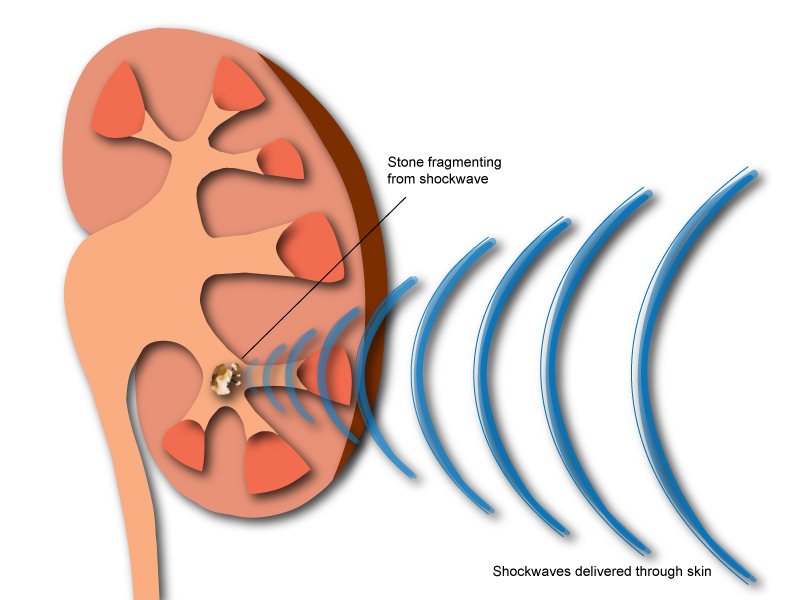
Extracorporeal shockwave lithotripsy uses focused sound waves to breakup your stones from outside your body. The advantage of this treatment approach is that instruments may not need to be introduced into your body (unless your stone is large, in which case a stent is usually placed at the time of surgery).
ESWL may be associated with less discomfort than other treatment options such as ureteroscopy or percutaneous nephrolithotripsy. However, ESWL does not usually have as high of a success rate as these other surgical treatment options and is more likely to require re-treatments. For more information on comparing the surgical options for kidney stones, see our comparison chart.
ESWL is easier to perform for stones that are visible on plain x-rays because this type of x-ray is used to target the stones during treatment. For stones that are not visible on plain x-ray, such as uric acid stones, special techniques can be used to allow ESWL to still be used. Stones that are less dense (which can be measured from CT scans) tend to respond better to ESWL than stones that are more dense.
ESWL can be used to treat both stones in the kidney and stones in the ureter. ESWL may not be as effective in patients who are obese because the increased body tissue can make it more difficult to visualize or treat stones.
Fast facts about ESWL:
- Typical operative time: 1/2 hour
- Usual hospital stay: No hospital stay, ESWL is outpatient surgery.
- Average number of days before going back to work: 3.3 days
- Average number of days before feeling back to normal: 8.1 days
Data regarding return to work and recovery from a study by Pearle and colleagues, Journal of Urology, 2005.
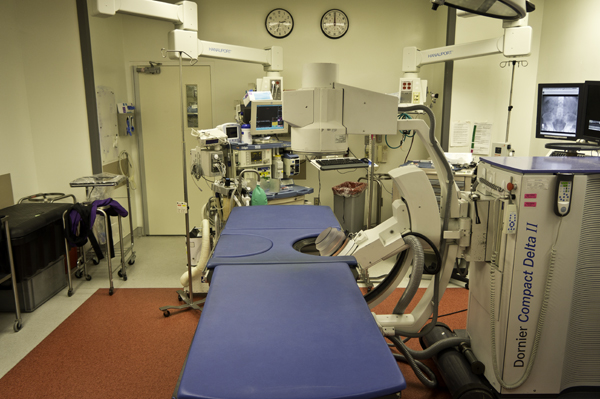
Photo of a Dornier ESWL table. Treatment head is positioned in the cutout on the right side of table. The patient’s back would be in contact with the treatment head during a procedure.
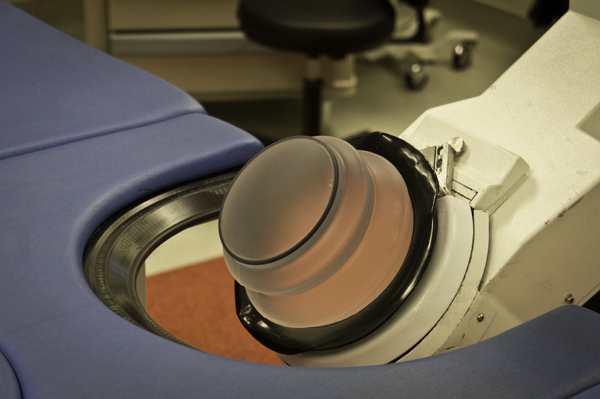
Closeup view of ESWL machine treatment head.
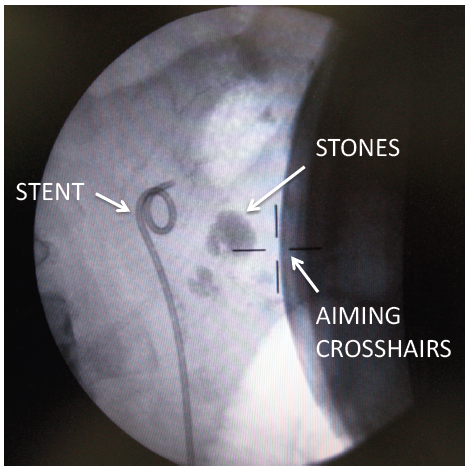
X-ray image from shockwave lithotripsy procedure prior to initiation of shocks. Large round dark structure on the right of the image is the fluid filled treatment head placed against the patient’s skin to allow transmission of the shockwaves. The surgeon uses the aiming crosshairs to target the shockwaves at the stone to be treated. This patient had a previously placed ureteral stent which can be seen in the left side of the image.
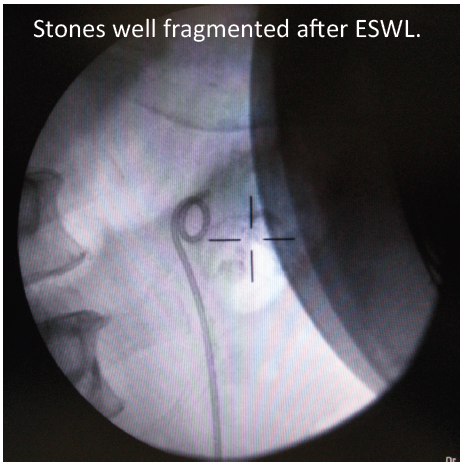
X-ray image at the end of the same shockwave lithotripsy procedure showing the previously easily seen stones were well fragmented into multiple smaller pieces by the 2,500 shockwaves administered during the procedure.
Is there anywhere you can get ESWL lithotripsy done without general anesthesia? Just sedation
Located in Mancherial, Telangana, Renin Superspeciality Hospital is a center of excellence for kidney health and nephrology services. Our hospital is dedicated to providing specialized care for patients with kidney disorders, offering treatments including dialysis, kidney stone management, hypertension control, and chronic kidney disease support. We combine expert medical knowledge with advanced technology to deliver personalized care and better outcomes. Renin Superspeciality Hospital is committed to raising the standard of kidney healthcare in the region with integrity, compassion, and clinical excellence. https://reninsuperspeciality.com/
Renin Superspeciality Hospital in Mancherial, Telangana, is a trusted name in advanced kidney care. We specialize in diagnosing and treating all types of kidney diseases, offering services such as dialysis, chronic kidney disease management, hypertension care, and kidney transplant consultations. Our expert nephrologists and compassionate staff provide world-class treatment using the latest medical technologies. At Renin Superspeciality Hospital, patient care and safety are our top priorities. Visit us to experience quality kidney care you can rely on.
Learn more: https://reninsuperspeciality.com/