
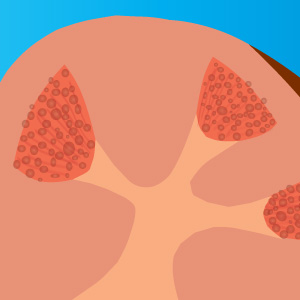
If, for some strange reason, you set out to design a kidney that could form stones as quickly as possible, you might end up with something like a medullary sponge kidney.
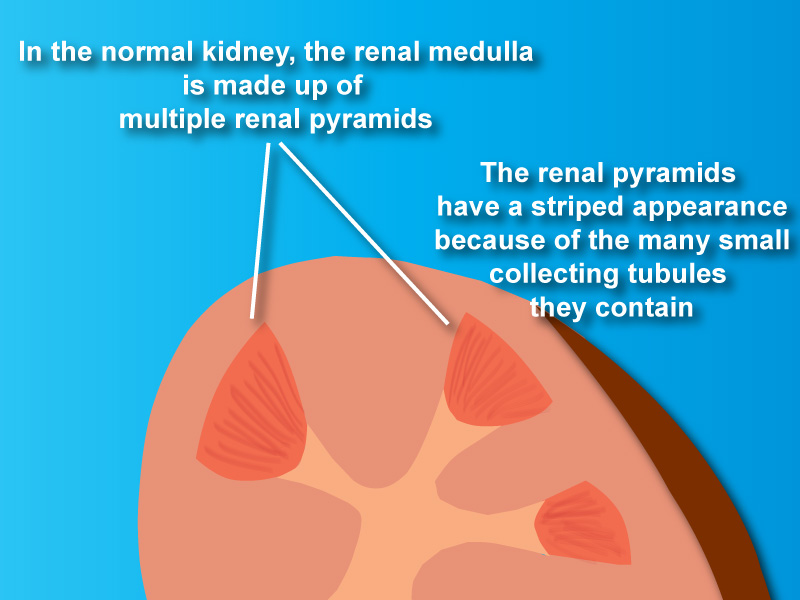
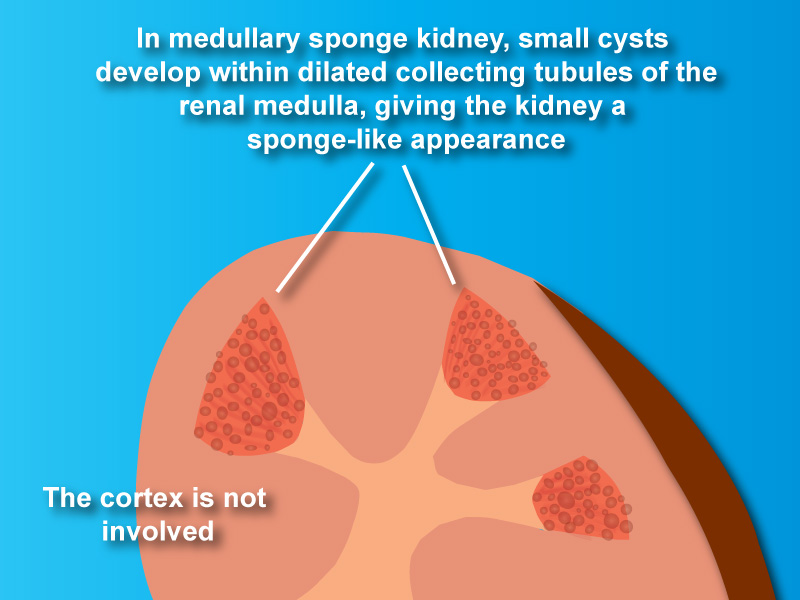
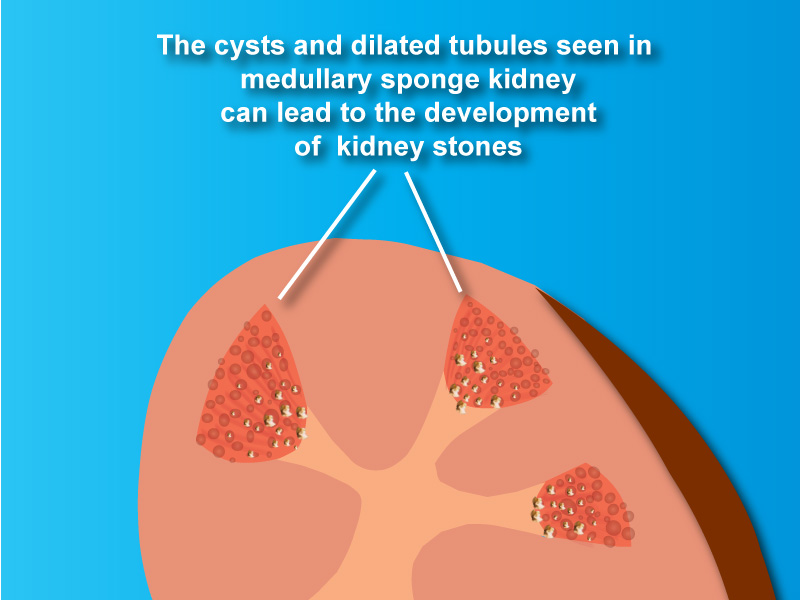
Medullary sponge kidney (MSK) is a condition in which a portion of the kidney known as the medullary pyramid is found to have dilated tubules (tubules are small tubes through which urine drains) and numerous small cysts (cysts are fluid filled hollow spaces). The cysts are small, measuring from 1 to 8mm, but are numerous. The cysts give the kidney, when cut, the appearance of a sponge – from which the name of “medullary sponge kidney” was coined. These cysts and dilated ducts lead to poor drainage, making it easier for stones to form. These abnormalities can be seen throughout both kidneys or may be localized in only one part of a kidney. The stones formed in MSK tend to be numerous and scattered throughout the kidney.
How do I know if I have medullary sponge kidney?
Medullary sponge kidney is felt to be non-hereditary (you don’t pass it on to your children). Many patients with MSK never develop problems and don’t know they have the condition. One study estimated that MSK may occur as commonly as 1 in 200 persons while other more conservative estimates report an occurrence rate of 1 in 5,000 to 20,000 persons.
Because many patients with MSK develop no symptoms and remain undiagnosed, reliable data on how many will form stones is not available. In one study of 56 patients from one hospital, the authors reported that 30% of the MSK patients that they studied never developed stones. Among the stone formers, MSK appears to be more common in females and usually first presents in the 30s.
The diagnosis of medullary sponge kidney is made with imaging studies, either with an intravenous pyelogram (an older type of x-ray) or with a contrast CT scan. These imaging studies will show a characteristic distribution of stones or calcifications in the location of the medullary pyramids and contrast pooling in dilated tubules. In order to confirm the diagnosis, the imaging study should include intravenous contrast in order to demonstrate the dilated tubules that are the hallmark of MSK. However, most CT scans for kidney stones are performed without contrast and in this case the diagnosis, while likely, is not considered definitive because other stone related conditions can also lead to an appearance similar to MSK on a non-contrast CT scan.
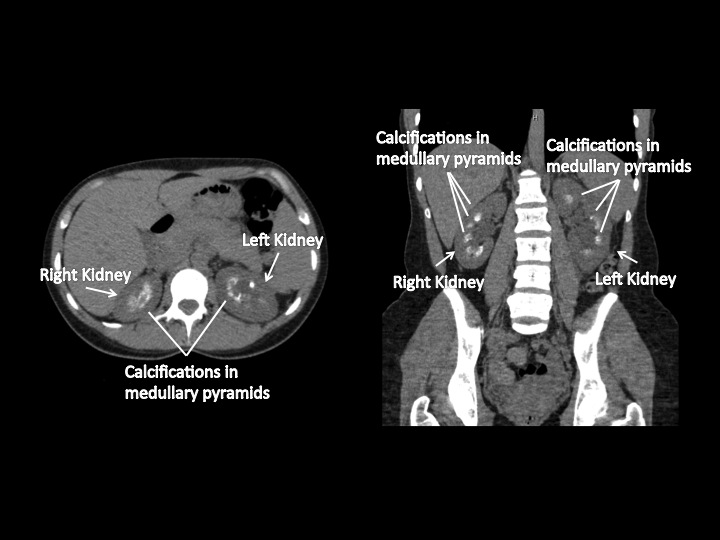 Non-contrast CT scan of a patient with medullary sponge kidney. Multiple stones and calcifications can be seen in both kidneys. To see examples of contrast accumulating in the medullary pyramids of MSK patients on a contrast CT scan or intravenous pyelogram, visit these sites: CT scan or intravenous pyelogram.
What are the symptoms of medullary sponge kidney?
McPhail and colleagues reported that among 56 patients with MSK, the most common presenting symptoms included:
- Flank pain in 52%
- Microscopic blood in the urine in 36%
- Visible blood in the urine in 16%
- Urinary tract infection in 7%
- Abdominal pain in 7%
- Testicular pain in 4%
- Imaging for other causes in 4%
What type of problems can medullary sponge kidney cause?
Individuals with MSK most commonly present with kidney stones, urinary tract infections, or blood in the urine. In individuals with MSK who form stones, other metabolic abnormalities that predispose someone to form stones are also commonly found, including hypercalciuria (high calcium levels in the urine) and renal tubular acidosis (a disorder with the kidney’s handling of acids).
It therefore appears that just having MSK by itself is not enough to form stones (30% of MSK patients don’t form stones). However, combine the abnormalities found in MSK with someone who has a metabolic tendency to form stones and you will often see an astounding number of stones developing throughout the kidneys.
X-rays for patients with MSK are often impressive for the sheer numbers of stones seen. Not all those stones will necessarily be in a position to drop into the ureter and cause traditional stone symptoms. In order to do so, the stones need to have access to the hollow collecting system portion of the kidney. Instead, many are often embedded in the solid tissue of the kidney (the parenchyma) where they are unlikely to result in a stone passage.
In some patients however, the non-obstructing stones seen in MSK can be associated with significant and chronic pain, even if they are not passing. The pain in this situation can be constant in nature, unlike the episodic pain traditionally seen with kidney stones. It is not certain what causes this pain but authors have proposed that the small numerous stones seen in MSK may cause obstruction of the small tubules and collecting ducts in the kidney, leading to the pain. This pain can be debilitating and treatment is challenging. Narcotic medication, even with large quantities, is often not adequate. Some success with pain control for MSK patients with this type of pain has been reported using laser lithotripsy (see below).
The most common stone types in MSK are calcium oxalate and calcium phosphate.
Thankfully, MSK does not commonly lead to kidney failure.
What can be done about medullary sponge kidney?
Treatment for MSK focuses on prevention and treatment of stones, management of pain, and prevention of infections. There is no treatment available to fix or remove the small cysts and dilated tubules associated with the condition.
In stone formers, maintaining a high fluid intake and treatment with hydrochlorothiazide (to lower urinary calcium) and/or potassium citrate (to raise urinary citrate) are used. Metabolic evaluation with urinary and blood testing can be used to identify specific metabolic abnormalities that increase a person’s risk for stones. In addition, some authors advocate the use of hydrochlorothiazide in all patients with MSK, even when urinary calcium levels are normal.
Treatment for stones that have already formed include the same approaches used for other stone patients, including ureteroscopy, shockwave lithotripsy, or less frequently, percutaneous nephrolithotripsy. Due to the large number of stones formed in MSK and the fact that many of those stones may not be within the collecting system, it is not usually necessary or possible to completely eradicate stones in a patient with MSK.
In patients who have chronic pain associated with MSK, ureteroscopy with laser lithotripsy (called “ureteroscopic laser papillotomy”) may be an option to relieve discomfort. The procedure involves fragmenting and extracting all visible stones in the kidney with the intent to “unplug” and clear obstructed ducts that may have stones trapped in them. In a paper from three institutions, Gdor and colleagues reported on their experience with a total of 65 patients who collectively underwent 176 procedures. All patients in the study had chronic flank pain and multiple non-obstructing kidney stones. 50 patients had followup information available. The majority of patients who underwent this procedure experienced a reduction in their pain (83%). On average, the duration of pain relief from surgery was 26 months. Of note, 17 of the patients in the study had a diagnosis of MSK and their pain relief was similar to that seen in non-MSK patients.
If you have been diagnosed with medullary sponge kidney, share your experience or ask a question below.
References:
Campbell-Walsh Urology 10th Edition, 2011.
McPhail and co-authors, “Nephrolithiasis in Medullary Sponge Kidney: Evaluation of Clinical and Metabolic Features”, Urology 2012.
“Medullary sponge kidney” National Kidney and Urologic Diseases Information Clearinghouse, 2008.
Gdor and co-authors, “Multi-Institutional Assessment of Ureteroscopic Laser Papillotomy for Chronic Flank Pain Associated with Papillary Calcifications”, Journal Of Urology 2011.
Editor’s note: This post was updated on 5/15/12 to include more information on diagnosis, pain related to medullary sponge kidney, and treatment options.
2 of our daughters have MSK. Our oldest daughter just had a kidney transplant and bilateral nephrectomy-11/2/21. Both daughters suffer severe back pain and UTIs. Our oldest daughte’s first nephrologist (who she got rid of) could not understand why she had back or flank pain. I should send him this article. Molly was at 13% kidney function when she had her transplant. Our other daughter is at 33% function. Also to note their grandma has MSK. By the way, the surgeon took pictures of Molly’s removed kidneys-disgusting!
I found this article so informative.
I am 31 years old and I have had it since birth but was barely diagnosed in my 20’s when it was getting worse and I had frequent UTI’s but now I am have other issues with it and as well as high blood pressure, and I am so use to the pain at times I don’t realize I am in pain really. I have been trying my best to follow doctors orders but it doesn’t seem to be working for me since, now. I have to deal with high blood pressure it stinks
My wife suffers from this, but didn’t know she had it and the 12+ other kidney conditions until in the past 5 years. She always had issues with stones when she was younger and throughout her pregnancies in her early 20’s (with her first husband) but they never properly diagnosed her and kept telling her it was UTI’s and sending her home with antibiotics. After we got married and moved out of state to the NE region of the US, was when she was diagnosed with her first kidney disorder when she, out of the blue, came down with severe pain and within hours had a fever over 111 degrees for 5+ hours. Yes, she survived and without brain damage. It did however damage her memory for a while but that has since stopped being an issue for everyday life anyways. 2008 was when she got her first ‘disorder’ diagnoses. Now, 2018, ten years later, she has around 15 kidney conditions with MDK being the largest benefactor of her chronic pain and have stage 3A of CKD. She’s had around 20 surgical procedures and we have gone through bankruptcy as a result of the medical expenses of one year that were over half a million, before they finally gave her disability and medical insurance to cover all of this. She still works, but only part time and/or when her body can deal with it. Like many of you, she can’t get on pain medication because of all the junkies that have ruined it for the people that actually need the ‘heavy’ stuff due to the intensity of pain involved with kidney disorders. Like many of you, your spouse also has to deal and/or suffer along with you/them because we have to pick up the pieces when our sick spouse can’t. I actually had to be trained to give medications to my wife for medication sessions that often last 3-4 weeks by PICC line, which left me in a position where I had to become self employed because of the intensity of care that often has to be given where medical insurance won’t cover in-home care for that kind of treatment.
They’ve done ‘clean outs’ and she’s had as many as 145 stones removed in just one surgery. She keeps producing them faster than they can safely do surgical procedures. The only ‘real’ solution is removal of the kidney causing the issue or both if you’re unlucky enough to have it in both sides. Though that isn’t really a solution, per se, it is an option. The other issue is, many doctor’s don’t tell their patients that MSK is linked to several other kidney disorders and many kidney disorders are actually caused by a liver disorder that goes undetected for X amount of years. Take calcification of the kidneys for example. This is actually caused from a disorder in the liver where it keep calling on the body to produce calcium when none extra is needed. Because of this overlooked condition, my wife lost her ability to have children unbeknown to the fact that her uterus was completely calcified because of the inability of her kidney’s to process and remove all that calcium which also caused calcification of her kidney’s (still in progress too). When she was forced to have hysterectomy this past year, the pulled her uterus out which was about 5 pounds in weight and looked like a rawhide. It had to be ‘cut out’ in strips, because it was too hard to fold up and be pulled out through the laparoscopic hole made for it.
Needless to say, if you have MSK, you’d better be sure you don’t have 15 other conditions that have been overlooked, because if you are young enough to have children safely (given the strain bad kidney’s can cause during pregnancy), or young enough that they could correct this early on, you should find out ‘now’ rather than later.
There are areas of the country that can handle diagnoses better and can deal with the condition(s) better than others. Midwest, NE, West Coast, Florida. Research, inform, and if they can’t handle your condition(s) where you are, you should consider moving somewhere where your life will be handled better so that you can have as productive of a life as you can with MSK and other kidney disorders.
https://mskspongelife.wordpress.com/2018/01/06/spongie-story-shannon/
My group joined the CIAAG.net
On Facebook: https://m.facebook.com/MedullarySpongeKidney/
Wouldn’t it be great to run more studies! Michigan Medicine is trying to help us surviving Cacchi-Ricci Disease:)
Vanderbilt University Hospital in Nashville, Tennessee is also a great place for treatment. I have been going there for the past 15 years. I too suffer from MSK. The surgeons and physicians are fantastic!
I have passed nearly 300 stones since I was 17 and I will be 34 this year, so half my life. I have had countless surgeries to remove or break them up. I have had so many stents which are more painful than the stones for me. Sometimes I have surgery 2 times a year or more. This year 4 times. I have had chronic flank pain the last 5 years or so even when not actively passing a stone. I was finally just diagnosed with MSK and they did a ureterscopic laser papillotomy which is essentially a complete kidney clean out of my right kidney. I’m having my left done in 4 weeks. My experience with the surgery was terrible but recovery 4 weeks later and I feel much better. Looking forward to getting the left done. The surgeon thinks I could have relief for a couple of years. I would love this. I do not take chronic pain medication. Only keep on hand in case of an emergency level of pain or for post op. It’s very frustrating that so many people have drug/addiction issues because I’m not one of those people. I’m a successful career woman, mom, and wife who just needs this sometimes and that is more difficult than it should be. I have had to be sedated the pain was so bad. I have never had a record of misusing my medications nor do I take very many. I’m hoping to be pain free and active for a couple of years or more after these surgeries.
I was diagnosed at 32 with MSK. I am now 35 and the pain gets so intense, I can’t sit still, I can’t get comfortable, I just pace and cry. My husband hates it, he feels so helpless. Thanks to all the pill heads, good meds are hard to get. When I get them, I use them sparingly. No stones passed so far. Keeping up with 3 in my left and 2 in my right. I have a few bad days but can manage the pain mostly. I feel terrible posting about pain after reading all the previous posts. You are all brave souls. God bless you all.
I was just diagnosed yesterday with chronic kidney disease or medullary nephrocalcinosis stage 1 … what Is the best rx from a doctor for Pain management of this disease? I’m so lost right now.
[…] I am thankful for Tim and our children… Their support makes it easier to deal with accepting this ongoing condition (Medullary Sponge Kidney). […]
I am a 69 female and was diagnosed with medullary sponge kidneys when I passed out and was brought to a hospital in 1982 35 years ago. I had stents place in both kidneys for a year or longer. When I sat down the stents hurt when they were finally taken out that night I had my husband push my legs to my chest and I could plop plop for so many stones plopped out. A few years later after more stone attacks. I had lisitrisipy and that made it worse so I just suffered and never had that again. I still have constant pain in lower and have a high tolerance to it. I have been on allopurinol for years and calcium citrate. I have oxylate stone they are the color of kidney bean. I should be on urocit k but Medicare does not cover it with my prescription d and. Cannot pay over 100 a month. I just got out of the emergency room two days I could tolerate the last stones. It would be helpful if government would help those living on social security more. Thank all of you for sharing. I do drink 4 bottles of water at nite and take Htcz water helps me to flush them out when it very painful Cynthia
I was diagnosed with MSK after a CT scan because of microscopic blood in my urine. I also had high calcium in my urine. After almost a year of high dose potassium citrate with little effect in lowering the urine calcium, the next step is HCTZ, however I am afraid of this drug as I do not have high blood, and actually tend to have low pressure. Is it safe for me to take this drug?
I started getting stones that resulted in surgery at the age of 24. I’m now 36 and just had my 12 surgery sense 2009 last week. I grow stones VERY quickly, even crusting on the stents post surgery if they’re left in for more than 2 weeks. I have had very large stones, but the majority are stones that never drop and crust over my entire kidney. I’m constantly full of stones on both sides, but my right lower back is where most of my pain localizes. I’m in constant pain. I end up in the ER many times throughout the year. Although I’ve struggled with this for 12 years now I just heard about MSK a few months ago when a second level specialist suggested it as a possibility. After reading up, I’ve self diagnosed myself as the poster child for this condition. I’m progressively getting worse with the surgeries increasing and ER visits too. It’s started to really effect my job and my life at home. I’m constantly worried about a sever attack and I don’t want to spend my life on pain medicine. I am not a drug seeker, but I don’t know how much longer I can handle being a martyr either. It seems like no one understands and my doctors are frustrated too. For the first time my last ureteroscopy with laser lithotripsy did not seem to reduce the pain in my right flank and that scares me. I don’t know if anyone else has had that not reduce the pain level? Thank you for sharing your stories. It’s nice to know I’m not alone, although I’m sad for anyone that has to go through this.
I’m sorry your in so much pain” my husband suffers to & no doctor will help us…
I was diagnosed with sponge kidneys via IVP in 1994. I passed my first stone 15 years later. I’ve had gross hematuria for 10 days when sick in Nov. Doctors don’t seem concerned. I have gross hematuria few times a year. I don’t even bother going in to the doctor anymore. I’m borderline hyperthyroid but because my lab is 0.07 in the normal range they won’t diagnose me, even with multiple symptoms. They want me on high dose calcium for osteopenia but wouldn’t that cause more kidney stone problems? They aren’t looking at the big picture or comparing labs over the years.
Hello fellow sufferers,
I was diagnosed with msk almost 25 years ago. I passed 2 stones and when I went to the er after x-rays the radiologist said he stopped counting after 200 stones! I went through lithotripsy, several stone extractions and potassium citrate treatment. I was fortunate enough to have a good urologist who was very aware of the disease even the early 90s. I have also been fortunate that I have only had to deal with passing stones one or two times a year. I have learned to just deal with the passing and mostly self treated.
Last week after several weeks of intense side and back pain and being treated for another condition (it turned don’t not to be this), I ended up in the er. My creatine levels were extremely high and I was admitted. A ct scan did not show any stones, however, a ct scan without contrast is not always reliable. I was treated with iv antibiotics, fluids and morphine for pain. I am to follow up next week for further treatment. The kidney doctor told me it wasn’t unusual to have pain without stones and it could be very hard to control the pain. I am still in pain today and my creatine levels are still high even though I was released from the hospital 3 days ago. I have always drank a lot of water but was never told to watch my diet other than my calcium intake. So it seems I am starting on a whole new road after more than 20 years.
I share all of this to say I believe there is a great deal about this disease that is not known. Doctors don’t always know and as sufferers we must push for more research and better information for the doctors treating us. If your doctor doesn’t believe you or just generally seems ignorant or apathetic to your condition, find another doctor. It seems a pain management doctor is usually recommended for pain. And a nephritis who is informed about msk may be the best way to go. For all of us I pray the good Lord above shows us and our doctors what we need and how to better provide for us. Prayers for all of us.
Melissa
Nephrologist not nephritis
Thanks so very much for this. I totally appreciate this and as it helps. I am not sure if it is MSK yet, as I have an appointment on Thursday. I do know that I have Punctate Parenchymal Stones (non-passible). My creatinine is 0.94, within the 0.66 – 1.25; my protein serum is high 8.4 (6.3 – 8.2); but my protein urine is negative; my urine PH is 8.5 of out 5.0 – 8.5; my potassium serum is 4.4 mmol/L out of 3.5 – 5.1.
I was just diagnosed yesterday from a CT scan with dye. Today I was told from an ultrasound perspective I do not have it (not by my physician).
Is this common? Does the CT trump the ultrasound?
When I was 27 or so I was diagnose with sponge kidneys. Now I’m 35 and was told I have good kidneys. Can it go away just as fast as it came?
No. Sounds like you were diagnosed incorrectly. I was just reading about how that can easily happen! Sometimes a radiologist and or doctor will want a imaging test done with die while others just use an ultrasound or other imaging looking like MSK (I am forgetting what it was that looks extremely similar…try googling it! That’s my answer to everything!) But you are indeed stuck with Medullary Sponge Kidney for life. I’m assuming both times renal imaging was looked at. Otherwise not sure how that would happen. Hope it helps!